By Eleanor J. Piazza
It's summer. Time to get the invitations in the mail for the annual ceremony to honor women in menopause. Time to organize the feast. Time to confer with this year's spokeswomen, flautist, firekeepers, drummers and singers.
The invitations always begin "Dear Sister, Daughter, Mother and Grandmother, you are invited to participate in a ceremony to honor Women of the Fourteenth Moon." The rest of the invitation is different every year, modified and revised as the ceremony itself evolves.
The name "Women of the Fourteenth Moon" came to me as I sought an honoring name for menopausal women. Simply, if there are thirteen full moons in a given year, a woman who has not had a period for a year will begin a new phase in her life upon the fourteenth full moon without bleeding. For most women, unless they have had a hysterectomy, there are skips and starts so it can take a long time to achieve this status. It is cause for celebration.
 To me, the name "Women of the Fourteenth Moon" is more empowering than "Crone," or "menopausal." It is empowering because not only the word "woman" is used, but "moon" is in the name, which identifies us with nature. Finally, "Women of the Fourteenth Moon" names an experience and tells of a phase in a woman's life.
Menopause, or "a pause of the menses," may be etymologically correct, but most of us have lost our sense of connection with the Latin root of that word and so we only know it intellectually. The aspect of "cessation" is not in keeping with the spirit of this celebration. The accent is on regeneration and beginning, not degeneration.
Women tell me they like being referred to as a Women of the Fourteenth Moon. I think rites of passage deserve titles, linguistic overtures. I wanted the language of the ceremony to reflect a time of grace and dignity in a woman's life.
The idea of this ceremony began in 1987 when a woman I know mentioned it had been a full year since she'd had a period and she hadn't done anything special to acknowledge this rite of passage. I knew instantly that I wanted to have a celebration for her, for other women in the community who were menopausal, and to prepare the way for myself when my time came.
How does one create a contemporary ceremony? I thought about all that was good and rich in the gatherings I had been to through the years.
Twenty years ago I sat in a circle with women for the first time. It was an honoring circle, only we didn't call it that. We called it a Women's Gestalt Workshop. It was in a beautiful natural setting on top of a mountain. The Gestalt therapist had certain guidelines. We had to make "I" statements, for example, to consciously own what we said. We expressed our fear, angry, grief and rage as Lesser, exemplified the crème de la crème as facilitators go: "Don't try to give me your power," she would counsel, "I have my own." Her workshops were rituals of empowerment.
A good ceremony, then, is empowering. The "inner teacher" is brought forth. One learns to trust oneself and not depend on the facilitator. I wanted the ceremony for Women of the Fourteenth Moon to be empowering for all women.
Jay encouraged us to begin circles of our own when we returned to our respective homes. She called what she did "community building." And so I did that. I still see some of these women and they are the nucleus of a very important community of friends for me. We stand by each other at births and weddings, through times of separation, floods and earthquakes.
I wanted the ceremony for Women of the Fourteenth Moon to be a safe place for women in my community to meet; a place where comfort, gentleness and support can be expected. I wanted a sense of continuity from year to year.
The next group of women I was involved with was a Santa Cruz writing collective, "Moonjuice," that evolved out of a writing class with Ellen Bass. This was about fifteen years ago. We met once a week for years and published several volumes of out poems. In our diversity, we found our uniqueness. We found the common threads of our womanness and we bonded. We were open and non-judgmental. We listened lovingly and carefully to the intricacies of each other's visions, ensconced in poems. We learned first hand that if we tell out truth, it has universal application.
I wanted the truth of woman's poetic voice to be heard at the ceremony for Women of the Fourteenth Moon and the diversity of my community to be reflected in those who participate.
Finally, every month for three years, I attended the women's full moon ceremony at a Native American spiritual community where I lived. Every full moon the women would gather on a little hill above the village around the sacred fire, prayerfully and purposefully. That has been almost ten years ago and I can still smell the sage, hear the rattles and see a tongue of flame leap up to accept a corn meal offering. For all those years I lived with an awareness of the cycle of the moon, Grandmother Moon, we called her, and her effect on my own moon cycle, rhythms and moods.
A menstruating woman was referred to as a woman on her moon. A lot of women are on their moon during full moon. This moon time was time each month for a woman to set aside for herself. A time to reconnect with her source in whatever way she does that. It is a time of great power for women.
I wanted to give the gift of Grandmother Moon to menopausal women who may not have had the opportunity to live with the effects if the rhythms of the moon consciously when they were younger. I wanted the ceremony for Women of the Fourteenth Moon to be instructive on these matters.
The community I lived in was intertribal and interracial. I wanted the ceremony for Women of the Fourteenth Moon to be inclusive, with a recognition of the elements of ceremony that are public domain, and come under the heading "natural," as opposed to being specifically African tribal, Neo-Pagan, Native American, Buddhist, Christian or Jewish.
Now I live in an eclectic community near Santa Cruz, California, where we meet in ceremony every year as Women of the Fourteenth Moon. We transcend age differences, religious, political and socio-economic backgrounds, sexual preferences and racial biases. We are united in our desire to connect with our own again process in a positive way and to honor those who go before us. We are united in our sincere desire to learn from one another about out life changes. In our rich family of women, we have researched and asked Grandmothers in Hong Kong, Honolulu, Guadalajara, Chicago, Marysville, Michigan, Templeton and Atlanta if they could tell us of words or deeds that which have once honored this time of change that all women who live so long do experience.
"Can you tell us about a ceremony, a special name for, or a consideration given to menopausal women?"
"Well, no, not really," comes the reply.
So, we must exalt the symbols of elder hood as we see them and create ceremonies appropriate for out own communities. This is an invitation to each of you to visualize and create a ceremony for yourself and the elders in your village.
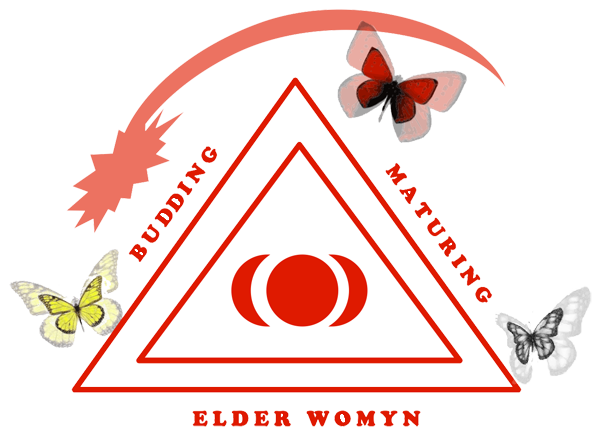 Small things emerge. We must seize the symbols. Take sage tea for example. Younger women serve this tea to the Women of the Fourteenth Moon at our ceremony. A younger woman would only drink sage tea to help dry up her milk if she is weaning her child. Only men and menopausal women drank the wild sage tea in the Native American community where I lived. It is an elder woman's privileged to drink this tea.
Throughout the year, if she wants to, a Women of the Fourteenth Moon can sip sage tea and remember t he tingling sensation in her hands as the Talking Stick was passed to her in the ceremony; she can remember the sweet scent of the wood smoke from our sacred fire, whiffs of cedar, pinon, sage and lavender. Perhaps she remembers the beat of the drums and how her heartbeat synchronized with that ancient sound, lending a deep sense of peace. Did she really see belly dancers twirling in the light of the fire? Well why not? Belly dancing was created by women, for women, as part of the birthing ritual. They were dancing for her, to honor her for her day of childbearing and nurturing. And what was it exactly that woman from Australia said? Something about not being afraid to age now because, as she put it, "for anyone who has eyes to seem elder women are quite beautiful."
Perhaps she pours another cup if team, our Women of the Fourteenth Moon, peers out the window to see if Grandmother Moon is up yet. Maybe she closes her eyes and sees the image of an elder in red who opened and closed each part of the ceremony with the sweetest prayers to the creator, words that teach, enlighten, comfort and invoke strength. And late, late into the night, this same woman danced the Dance of Crone, agile, fluid, surefooted and barefooted on Mother Earth.
Maybe, in this reverie, our Women of the Fourteenth Moon sees an altar with eagle feathers and a turtle shell, little bowls with earth and water in them, wands of sage and mystery bundles. Maybe, just maybe, she tunes in to ancient visions of her own heritage. When she opens her eyes she could see the Woman's Staff she was given at the ceremony or the pottery bowl she received at the giveaway.
Ceremonies are experiential and unique to each community that creates them. I believe that the essence of ceremony is simplicity. We are fortunate to have the skeleton, the bones, of our community provides. We are black, white, red, yellow and brown. Every year we flesh it out differently, and every year we learn from the ceremony itself. It is an entity unto itself and it teaches us about power and control, about giving and receiving, about humility, self esteem, appreciation, friendship, community and much much more. Each woman who attends, attends her own unique ceremony.
Surely this is magic.